
How Prediction Market Works?A Complete Guide to Pricing and Mechanisms

Prediction markets are built around a simple idea: people express what they think will happen in the future by trading contracts tied to real-world outcomes. Instead of focusing on asset value, the system reflects probability, where prices move based on how participants interpret new information as it appears.
In recent years, platforms like Polymarket have made this model more visible by allowing users to trade on events such as elections, economic data, and crypto market movements. As more participants enter these systems, prediction markets begin to show how collective expectations form and shift in real time.
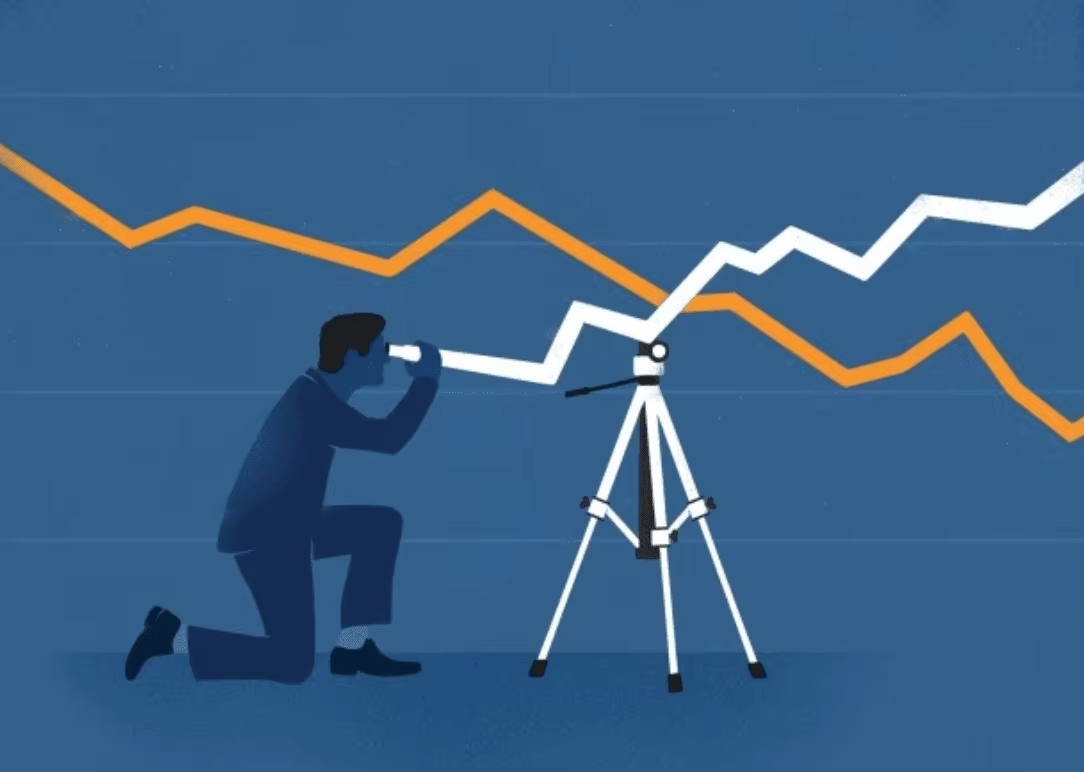
What is a Prediction Market?
Prediction market is a system where users trade contracts based on the outcome of future events. These events can include political elections, economic indicators, financial markets, crypto trends, or global developments.
Unlike traditional markets, prediction market does not focus on asset value. Instead, it focuses on probability. Each contract represents whether a specific outcome will happen.
If the event occurs, the contract settles at a fixed value. If it does not, it expires worthless. This simple structure allows prediction market systems to convert opinions into pricing.
How Prediction Market Works in Practice?
Prediction market works by allowing participants to buy and sell event-based contracts. Prices move based on supply and demand, reflecting the changing probability of an event.
A contract priced at 0.70 means the market assigns a 70% chance of that outcome happening.
When new information enters the system, traders adjust their positions. Some react immediately, while others wait for confirmation before acting. These differences create continuous price movement.
Over time, prediction market pricing becomes a reflection of collective expectations rather than individual forecasts.

Why Prediction Market Matters?
Prediction market matters because it transforms opinions into measurable signals.
Instead of relying on static forecasts or delayed reports, prediction market systems react in real time to new information.
This makes them useful for understanding expectations around financial markets, political events, economic data, and broader global developments.
As participation increases, prediction market signals often become more refined and responsive.
Prediction Market as an Information Layer
Prediction market functions as a live information layer where thousands of individual judgments are combined into one price signal.
Rather than relying on a single authority or model, prediction market aggregates distributed knowledge across participants.
However, accuracy depends on participation and liquidity. More active markets tend to produce more stable and reliable probability signals.

How Polymarket Fits Into Prediction Market Systems?
Polymarket is one of the most widely recognized platforms in the prediction market space.
It allows users to trade on real-world outcomes such as elections, inflation data, crypto trends, and geopolitical events.
Unlike traditional financial platforms, Polymarket focuses entirely on outcomes rather than asset ownership.
Its growth has helped bring prediction market concepts into mainstream discussions, especially within crypto and digital asset communities.
Polymarket and Real-Time Market Behavior
Polymarket is often used as a reference point for how prediction market systems behave under real conditions.
When new information appears, prices adjust quickly as traders reposition based on updated expectations.
In many cases, Polymarket reflects shifts in sentiment faster than traditional media coverage, since participants respond directly to information flow.
This makes it a useful example of how prediction market logic works in practice.

How Participants Behave in Prediction Market Systems
Prediction market behavior is shaped by how participants process information and respond to changing conditions.
When new events appear, some participants act quickly based on initial interpretation, while others take more time to reassess before making decisions. This difference in timing can lead to short-term price fluctuations.
Trading decisions are also influenced by how individuals evaluate uncertainty and decide how much risk they are willing to take in a given situation. As a result, market activity can shift depending on overall confidence levels.
Limitations of Prediction Market Systems
Despite its strengths, prediction market is not without limitations.
Some markets suffer from low participation, which can reduce accuracy. Others may experience short-term distortions caused by speculative trading.
Regulatory differences across regions can also affect how prediction market platforms operate.
Because of this, prediction market results should always be interpreted as probabilities rather than certainties.
Future of Prediction Market
The future of prediction market is closely linked to how global information systems evolve.
As more participants join prediction market platforms, pricing becomes more efficient and representative of collective expectations.
Blockchain infrastructure may further improve transparency and settlement reliability.
Platforms like Polymarket suggest that prediction market systems may continue expanding into mainstream decision-making environments.
Over time, prediction market could become a standard layer for understanding uncertainty in both financial and non-financial contexts.
Conclusion
Prediction market represents a shift in how information is priced and interpreted.
Instead of relying on static forecasts, prediction market systems continuously update based on collective behavior and real incentives.
Polymarket has played an important role in demonstrating how prediction market works in real environments.
As adoption grows, prediction market is likely to become a more important tool for understanding expectations and future outcomes across global markets.
FAQ
1. What is a prediction market?
A prediction market is a system where users trade contracts based on future outcomes.
2. How does prediction market work?
It works by pricing probabilities through buying and selling event-based contracts.
3. Why is Polymarket important?
Polymarket is one of the most well-known platforms that shows how prediction market works in real-world events.
4. Can prediction market be accurate?
It can be accurate when liquidity is strong and participants are well-informed, but it should still be treated as probabilistic.
5. What affects prediction market prices?
Prices are affected by new information, participation levels, and liquidity conditions
You may also like

What is Abbott Tokenized Stock (Ondo)(ABTON) Coin? A comprehensive guide you shouldn’t miss
Abbott Tokenized Stock (Ondo) (ABTON) is a tokenized representation of Abbott Laboratories equity that mirrors ABT price exposure…

What is PRIMIS Crypto? Real Utility or Narrative Play?
PRIMIS crypto sits at the intersection of Solana AI tokens, DePIN crypto, and GPU compute crypto—promising an AI…

Can PRIMIS Coin Hit $0.1? How to Buy Primis Protocol?
PRIMIS sits in the Solana AI niche as an “AI compute pricing layer” rather than a GPU marketplace.…

What is Kintara(KINS) Coin? A Comprehensive Guide to KINS/USDT, Utility, Risks, and Where to Buy
Kintara(KINS) Coin is a Solana-based memecoin with a utility angle: it powers a retro isometric play-to-earn MMO built…

What Is T-Mobile US Tokenized Stock (Ondo)(TMUSON) Coin? Comprehensive Guide, How It Works, Where to Buy, and What Should You Do
T-Mobile US Tokenized Stock (Ondo)(TMUSON) Coin is a tokenized stock asset designed to give holders economic exposure similar…

Spot vs Futures Trading: Which Strategy Fits Crypto Traders in 2026?
Spot trading and futures trading are evolving alongside crypto markets in 2026. As volatility rises and trading behavior shifts, many investors are asking the same question: which strategy makes more sense in today’s market?

Is XAUt a Good Investment in June 2026? Crypto Gold Guide
XAUt is trending amid macro drama. Check if digital gold makes sense now and explore the XAUt & PAXG Trading Campaign on WEEX to secure your bonus.

Is USWR Crypto Legit? A 2026 Guide to the United States Water Reserve Token
Is USWR crypto legit? Read the latest 2026 guide to United States Water Reserve, including price, market cap, liquidity, verification, and risk.
Investing in Scarcity: Is the USWR Crypto Pair the Ultimate "Michael Burry" Trade?
USWR crypto pair explained with live price, market cap, liquidity, water scarcity, AI demand, and a Michael Burry-style contrarian trade angle.
USWR Price Outlook: Why Traders Are Watching United States Water Reserve as the Next RWA Trend
The next big RWA trend? Learn why traders are watching United States Water Reserve (USWR), latest market data, Solana token details, risks, and what to know before trading.
What Is United States Water Reserve (USWR)? Latest Price, Risks, and What to Know Before You Trade
What is United States Water Reserve (USWR)? Learn the latest USWR price, Solana token details, risks, market cap, liquidity, and what to know before you trade.

Degen Crypto Price Prediction: Can DEGEN Bridge Meme and Utility?
DEGEN crypto price prediction for 2026, 2027, and 2030. Explore whether DEGEN can bridge meme and utility with Base growth, Degen Chain, and latest market data.
Is DEGEN Crypto Safe? Key Risks of Investing in DEGEN and Degen Chain
Is DEGEN crypto safe? Learn the key risks of investing in DEGEN and Degen Chain, including volatility, bridge risk, whale moves, liquidity, audit status, and latest market data.
What Is Degen (DEGEN) Crypto? The Ultimate Guide for Beginners
What is DEGEN crypto? Learn about DEGEN token, Degen Chain, latest price, market cap, supply, use cases, exchange listings, and why DEGEN matters in 2026.

Federal Oil Reserve Stock: Can You Invest in the SPR in 2026?
There is no federal oil reserve stock — the SPR is U.S. government property. See the 2026 drawdown numbers and how traders actually get oil exposure.
CDOF Price Prediction 2026–2030: How Far Can the Oil Token Go?
CDOF trades near $0.0077 with a $7.7M cap. This CDOF price prediction maps bear, base and bull scenarios for 2026–2030 — plus the real math behind $1.

SpaceX Stock Price: $135 IPO, Valuation, and How to Trade SPCX
SpaceX stock price today: a $135 IPO price, $1.75T valuation, and SPCX listing June 12, 2026. How traders get exposure before and after the IPO.
American Oil Asset Fund (AOAF) Explained: Is the Token Legit?
American Oil Asset Fund (AOAF) is a Solana token with an oil-reserve narrative. What it claims, what's verifiable, the red flags, and how trading works.
What is Abbott Tokenized Stock (Ondo)(ABTON) Coin? A comprehensive guide you shouldn’t miss
Abbott Tokenized Stock (Ondo) (ABTON) is a tokenized representation of Abbott Laboratories equity that mirrors ABT price exposure…
What is PRIMIS Crypto? Real Utility or Narrative Play?
PRIMIS crypto sits at the intersection of Solana AI tokens, DePIN crypto, and GPU compute crypto—promising an AI…
Can PRIMIS Coin Hit $0.1? How to Buy Primis Protocol?
PRIMIS sits in the Solana AI niche as an “AI compute pricing layer” rather than a GPU marketplace.…
What is Kintara(KINS) Coin? A Comprehensive Guide to KINS/USDT, Utility, Risks, and Where to Buy
Kintara(KINS) Coin is a Solana-based memecoin with a utility angle: it powers a retro isometric play-to-earn MMO built…
What Is T-Mobile US Tokenized Stock (Ondo)(TMUSON) Coin? Comprehensive Guide, How It Works, Where to Buy, and What Should You Do
T-Mobile US Tokenized Stock (Ondo)(TMUSON) Coin is a tokenized stock asset designed to give holders economic exposure similar…
Spot vs Futures Trading: Which Strategy Fits Crypto Traders in 2026?
Spot trading and futures trading are evolving alongside crypto markets in 2026. As volatility rises and trading behavior shifts, many investors are asking the same question: which strategy makes more sense in today’s market?


